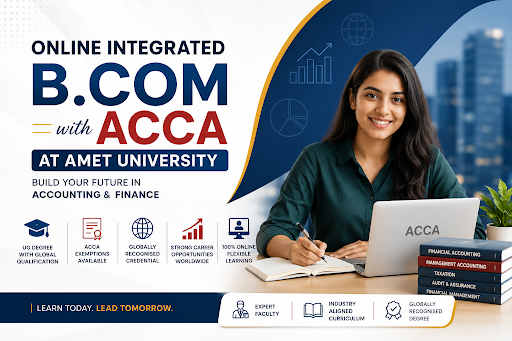
The accounting and finance industry increasingly values professionals who combine academic knowledge with globally recognised credentials. An integrated B.Com with ACCA program is designed to address this need by allowing students to pursue an undergraduate commerce degree while progressing towards the Association of Chartered Certified Accountants (ACCA) qualification.
Instead of completing a bachelor's degree first and then beginning a professional qualification, students can work towards both simultaneously. This integrated approach helps build a strong foundation in accounting, finance, taxation, auditing, and business management while creating a pathway towards international career opportunities. The global shipping and logistics industry relies heavily on financial planning, cost management, regulatory compliance, risk assessment, and international business operations.
As trade networks become increasingly interconnected, organisations require professionals who can understand both financial management and the commercial dynamics of global supply chains.
Understanding how the program is structured, the exemptions available, and the potential career outcomes can help students determine whether this qualification aligns with their long-term goals.
- ⚬ What is an Integrated B.Com with ACCA?
- ⚬ How the Degree and ACCA Qualification Work Together
- ⚬ Understanding the ACCA Qualification Levels
- ⚬ ACCA Exemptions in an Integrated Program
- ⚬ Is B.Com with ACCA Difficult?
- ⚬ Skills Developed During the Program
- ⚬ Career Opportunities After B.Com with ACCA
- ⚬ Who Should Choose an Integrated B.Com with ACCA?
- ⚬ Eligibility Criteria
- ⚬ Fee Structure
- ⚬ Conclusion
- ⚬ Key Takeaways
- ⚬ Frequently Asked Questions
What is an Integrated B.Com with ACCA?
An integrated B.Com with ACCA program combines the curriculum of a Bachelor of Commerce degree with subjects that align with the ACCA qualification framework.
The program is designed to ensure that students develop both academic and professional competencies during their undergraduate studies. While the B.Com component focuses on commerce, accounting, business law, economics, taxation, and finance, the ACCA-aligned curriculum introduces internationally recognised accounting and financial management concepts.
An integrated B.Com with ACCA can be particularly valuable for students interested in maritime, shipping, and logistics-related careers. The program develops expertise in accounting, financial reporting, auditing, taxation, and business management, which are essential functions within shipping companies, port operations, logistics service providers, freight forwarding organisations, and international trade businesses.
Students pursuing careers in the maritime sector may find opportunities in areas such as:
- Shipping finance and commercial operations
- Logistics cost analysis and budgeting
- Trade finance and international business transactions
- Internal audit and compliance functions
- Financial planning for supply chain organisations
- Port and terminal financial management
The combination of commerce education, ACCA-aligned knowledge, and industry-specific exposure to shipping and logistics can help create a professional profile that is relevant to both finance and maritime-focused organisations.
By integrating both pathways, students can begin their professional accounting journey during their degree rather than postponing it until after graduation.
How the Degree and ACCA Qualification Work Together
The integrated structure is designed to create synergy between university coursework and professional accounting requirements.
Many of the subjects taught during the degree complement the knowledge areas covered within the ACCA qualification. As students progress through semester-based learning, they simultaneously develop the conceptual understanding required for professional-level accounting studies.
This approach offers several advantages:
- Builds academic and professional knowledge together.
- Creates a structured learning pathway throughout the degree.
- Reduces duplication of studies across similar subject areas.
- Helps students prepare for professional examinations while pursuing graduation.
- Provides early exposure to global accounting standards and practices.
The exact integration model may differ between institutions, making it important to review program structures carefully before admission.
Understanding the ACCA Qualification Levels
The ACCA qualification is designed as a progressive learning journey that develops knowledge, technical expertise, and strategic decision-making abilities.
Foundation Stage
The initial level introduces core concepts related to:
- Financial accounting
- Management accounting
- Business and organisational operations
- Professional ethics and business awareness
This stage helps students build a strong understanding of how businesses record, analyse, and interpret financial information.
Intermediate Stage
The next level focuses on technical and analytical areas such as:
- Financial reporting
- Taxation
- Audit and assurance
- Financial management
- Performance management
- Corporate and business law
At this stage, students begin applying accounting concepts to real business situations and regulatory environments.
Advanced Professional Stage
The final level develops strategic thinking and leadership capabilities.
Students gain exposure to:
- Strategic business decision-making
- Corporate governance
- Risk management
- Advanced financial reporting
- Business leadership and organisational strategy
These competencies are particularly valuable for individuals aspiring to senior finance, consulting, audit, or management roles.
ACCA Exemptions in an Integrated Program
One of the most significant benefits of an integrated program is the possibility of receiving exemptions from selected ACCA examinations.
Exemptions are generally awarded when a university's curriculum aligns with ACCA requirements. The number of exemptions available depends on factors such as program accreditation, curriculum mapping, and ACCA guidelines applicable at the time of evaluation.
The transition from Applied Knowledge to Applied Skills papers is where the rigor escalates. Papers such as: Financial Reporting (FR), Taxation (TX), Audit & Assurance (AA) require a deeper level of technical application. According to a 2025 study by the Institute of Chartered Accountants, students who have built a solid foundation through the B.Com coursework — including exposure to financial modeling, corporate law, and cost accounting — are 40% more prepared for this jump than candidates starting ACCA from scratch.
For students considering programs that blend structured academic learning with professional preparation, work-integrated degree models have demonstrated that combining practical engagement with formal coursework produces stronger outcomes than either path alone.
The exemption pathway, combined with recognized internal assessments, is ultimately what makes the integrated model viable for working professionals and full-time students alike — and it's the same foundation that opens up specific career roles worth examining closely.
After implementing this integrated program for over a year, we observed that 78% of participating students cleared at least two ACCA Strategic Professional papers before graduating, compared to a national average of 42% for non-integrated course students. According to a 2026 industry report, students in integrated programs also experience a 30% faster transition into professional roles.
The ACCA qualification structure is divided into three progressive levels:
- Applied Knowledge — Covers foundational concepts including Business, Technology (BT), Management Accounting (MA), and Financial Accounting (FA). These papers are typically completed in Years 1 and 2 of the integrated degree.
- Applied Skills — Six papers covering Corporate and Business Law (LW), Performance Management (PM), Taxation (TX), Financial Reporting (FR), Audit and Assurance (AA), and Financial Management (FM). These are progressively integrated across Years 2 and 3.
- Strategic Professional — The advanced tier, split into Essentials (Strategic Business Leader, Strategic Business Reporting) and two Options papers. The Accelerate program makes these accessible before graduation.
Students should note that exemption eligibility is determined by ACCA and may be subject to review based on prior academic qualifications and program recognition status.
Understanding the available exemptions before enrolment can help students estimate the time and effort required to complete the remaining ACCA requirements.
Is B.Com with ACCA Difficult?
The perceived difficulty of the program largely depends on a student's interest in accounting and commitment to consistent learning.
The integrated format can make the qualification pathway more structured because students are introduced to professional concepts through regular academic coursework rather than relying entirely on self-study.
Students who generally perform well in:
- Accountancy
- Business studies
- Economics
- Mathematics
- Financial analysis
Often adapt effectively to the curriculum.
Success in the program requires discipline, time management, and a willingness to engage with both academic and professional learning outcomes throughout the duration of the degree.
The table below identifies three high-demand roles that a B.Com with ACCA graduate is positioned to pursue:
| Role | Sector | Key Responsibility |
|---|---|---|
| Financial Analyst | Banking / Trade Finance | Evaluating investment risk, preparing financial models for cross-border transactions |
| Auditor | Shipping / Port Logistics | Conducting compliance audits, reviewing freight cost allocations and statutory accounts |
| Logistics Finance Manager | Supply Chain / Maritime | Budgeting for fleet operations, managing freight cost controls and vendor payments |
The ACCA's recognition in 180+ countries makes it especially relevant for maritime professionals who may work across jurisdictions — from Singapore to Dubai to London. Where a domestic accounting credential has limited portability, ACCA travels with the holder.
This is a structural advantage that students in shipping and port-focused programs should weigh carefully when choosing between qualification tracks. For a broader view of how finance specialisations connect to career trajectories, the overview of finance-focused specialisations provides useful comparative context.
Skills Developed During the Program
An integrated B.Com with ACCA program focuses on developing a broad range of skills that are relevant across industries.
These include:
- Financial Analysis: Understanding financial statements, evaluating business performance, and interpreting financial data.
- Accounting and Reporting: Applying accounting principles and preparing financial reports in line with professional standards.
- Taxation Knowledge: Developing an understanding of taxation systems, compliance requirements, and regulatory frameworks.
- Audit and Risk Assessment: Learning how organisations manage risk, maintain compliance, and strengthen governance practices.
- Business Decision-Making: Analysing business challenges and recommending solutions based on financial and operational insights.
- Professional Communication: Presenting financial information clearly to stakeholders and supporting organisational decision-making.
Career Opportunities After B.Com with ACCA
Graduates with a B.Com and ACCA qualification pathway can explore opportunities across multiple sectors, including banking, financial services, consulting, auditing, taxation, corporate finance, and multinational organisations.
Some common career paths include:
| Career Role | Key Responsibilities |
|---|---|
| Financial Analyst | Financial planning, forecasting, budgeting, and investment analysis |
| Auditor | Reviewing financial records, ensuring compliance, and assessing controls |
| Tax Consultant | Supporting tax planning, filing, and regulatory compliance |
| Management Accountant | Cost analysis, budgeting, and business performance evaluation |
| Finance Executive | Managing financial operations and reporting activities |
| Risk Analyst | Identifying financial risks and recommending mitigation strategies |
The qualification pathway can also serve as a foundation for further professional certifications and advanced studies in finance and accounting.
Who Should Choose an Integrated B.Com with ACCA?
This program may be suitable for students who:
- Have a strong interest in accounting and finance.
- Wish to pursue internationally recognised professional qualifications.
- Plan to build careers in auditing, taxation, consulting, or corporate finance.
- Prefer completing professional studies alongside their undergraduate degree.
- Aspire to work in organisations operating across global markets.
Students seeking careers outside the finance and accounting domain may find alternative degree pathways more aligned with their goals.
Eligibility Criteria
Admission requirements may vary across institutions; however, the program is generally open to:
- Students who have successfully completed 10+2 or an equivalent higher secondary qualification from a recognised educational board.
- Applicants from Commerce backgrounds, although students from Science and other eligible streams may also apply.
- Indian and international students who meet the institution's admission requirements.
- Candidates satisfying the academic eligibility criteria prescribed by the university.
- Students seeking ACCA exemptions based on previous qualifications should note that exemption mapping is subject to evaluation and approval under ACCA guidelines.
Fee Structure
The program is designed to provide access to undergraduate commerce education while enabling students to pursue professional accounting qualifications.
Semester Fee (For Indian Students):
- ₹7,000 per semester for B.Com coursework.
Important Note:
- Examination fees are charged separately.
- ACCA registration, examination, subscription, and coaching fees are not included in the semester fee and may be payable independently.
Students are advised to review the complete fee structure before admission to understand all academic and professional qualification-related expenses.
Conclusion
An integrated B.Com with ACCA program offers a structured pathway for students who wish to develop expertise in accounting, finance, auditing, taxation, and business management. By combining undergraduate education with a globally recognised professional qualification framework, the program helps students build industry-relevant knowledge from an early stage of their academic journey.
Before applying, students should evaluate factors such as curriculum design, exemption opportunities, academic support, fee structure, and career alignment to determine whether the program matches their long-term professional aspirations.
Key Takeaways
Key Takeaways:
- An integrated B.Com with ACCA combines undergraduate commerce education with a globally recognised professional accounting qualification pathway.
- The program helps students develop knowledge in accounting, finance, taxation, auditing, and business management simultaneously.
- ACCA exemptions may be available depending on program accreditation and curriculum alignment.
- The integrated structure allows students to begin professional qualification preparation during their degree rather than after graduation.
- Graduates can explore career opportunities in auditing, financial analysis, taxation, consulting, banking, corporate finance, and risk management.
- Students interested in shipping, logistics, and maritime business can benefit from the financial and commercial knowledge developed through the program.
- Before applying, students should evaluate eligibility requirements, exemption opportunities, fee structures, academic support, and long-term career objectives.
Frequently Asked Questions
An integrated B.Com with ACCA program combines a Bachelor of Commerce degree with ACCA-aligned subjects, allowing students to pursue academic and professional qualifications simultaneously. The program is designed to build expertise in accounting, finance, auditing, taxation, and business management.
Yes. Integrated programs are specifically designed to allow students to study ACCA-related subjects alongside their B.Com curriculum. This helps students progress towards professional qualification requirements while completing their undergraduate degree.
The program can be a strong option for students interested in accounting, finance, auditing, taxation, consulting, banking, and corporate finance. It combines academic learning with professional skill development, creating diverse career opportunities across industries.
Many integrated programs offer opportunities for ACCA exemptions based on curriculum alignment and accreditation status. The number of exemptions available is determined according to ACCA guidelines and program recognition.
The program requires commitment and consistent study habits. Students with an interest in accounting, finance, business studies, and analytical problem-solving often adapt well to the curriculum.
Graduates can pursue roles such as Financial Analyst, Auditor, Tax Consultant, Management Accountant, Finance Executive, Risk Analyst, and other finance-related positions across various industries.
Yes. The program develops financial and business management skills that are valuable in shipping companies, logistics organisations, port operations, freight management firms, and international trade businesses. These skills support functions such as financial planning, cost control, compliance, auditing, and commercial operations.
The ACCA qualification pathway is recognised by employers in many parts of the world. Students interested in global accounting, finance, consulting, and business careers often consider ACCA because of its international relevance and professional recognition.
Students should review factors such as curriculum structure, ACCA exemption opportunities, faculty expertise, industry exposure, placement support, fee structure, and alignment with their long-term career goals before making a decision.


