There’s a quiet contradiction playing out in Indian offices and homes every evening.
A 24-year-old accounts executive in Pune is doing the work of a commerce graduate — reconciling ledgers, preparing GST filings, managing vendor payments — but doesn’t hold the degree that would formally recognise those skills. Three desks away, a 30-year-old with 6 years of banking experience is being passed over for a promotion because her qualification doesn’t match the revised job description.
Meanwhile, universities across India have quietly opened a door that most people don’t know exists yet: the ability to earn a full, UGC-recognised online B.Com degree in India — not a certificate, not a diploma — without leaving your job, your city, or your current income.
This isn’t a shortcut. It’s a structural shift in how formal education now works.
- ⚬ What This Shift Actually Means (And What Most People Miss)
- ⚬ The Human Reality Behind the Numbers
- ⚬ The Decision Layer: Who Should Actually Pursue This?
- ⚬ What happens if this is ignored?
- ⚬ The Programme as a Structured Solution: Online B.Com Degree in India
- ⚬ Curriculum, Skills and Application: A Closer Look
- ⚬ How to Apply: Admission in 5 Simple Steps
- ⚬ Where This Is Heading: The 3–5 Year Outlook
- ⚬ Frequently Asked Questions
What This Shift Actually Means (And What Most People Miss)
The University Grants Commission’s approval of online degrees from recognised institutions changed something fundamental — it gave working professionals legitimate academic standing without the penalty of pausing their lives.
But here’s what most people gloss over: this isn’t just about convenience. The real implication is economic.
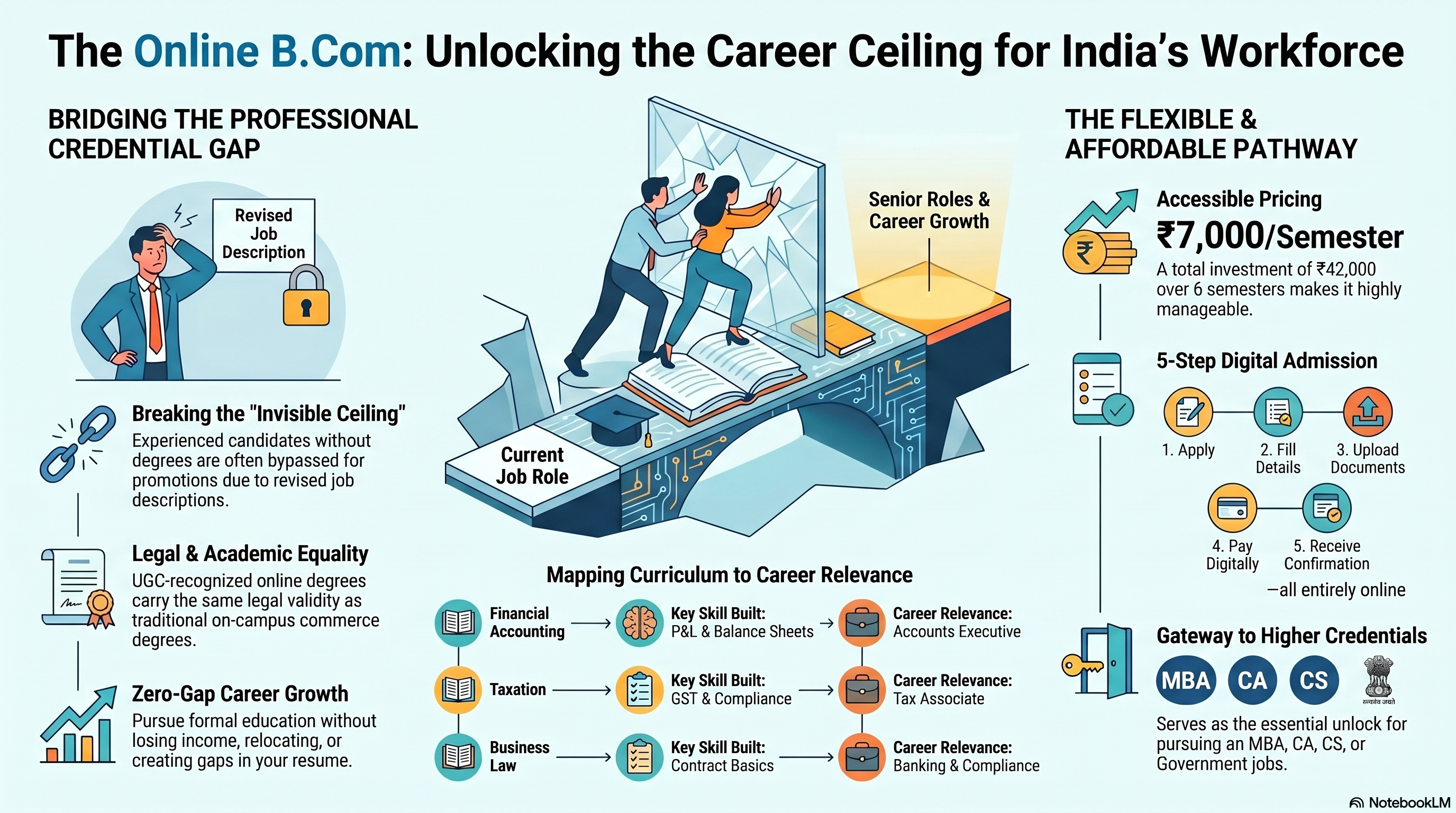
A pattern emerges when you look at the commerce job market closely. Employers increasingly filter for graduation as a baseline requirement — not because they believe a degree alone makes someone competent, but because it signals a certain threshold of structured thinking, accountability, and domain exposure. Without it, experienced candidates hit invisible ceilings.
The online B.Com degree in India closes that gap without creating a new one — loss of income, relocation costs, or a gap on the resume.
One of the biggest gaps in how people think about online degrees is the assumption that they’re “lesser.” In reality, UGC-recognised online B.Com degrees carry the same legal and academic validity as regular ones. Employers who matter already know this.
The Human Reality Behind the Numbers
Walk through a few scenarios that are more common than most people admit:
- The 12th pass earner: Who jumped straight into a family business or a data entry job at 18, now 25, is watching colleagues with degrees move faster in the same company.
- The dropout: Someone who started college, left due to financial pressure or family circumstances, and has been functioning professionally for years without the certificate to show for it.
- The career switcher: Who came from a non-commerce background — maybe arts or a vocational stream — but has been handling accounts, billing, or finance operations and wants to formalise that transition.
In most cases, the decision not to pursue a degree earlier wasn’t laziness. It was a trade-off. The online B.Com degree in India now lets people revisit that trade-off without the original cost attached to it.
The Decision Layer: Who Should Actually Pursue This?
This is where most blogs stop being useful. Let’s be direct.
This is the right path if you:
- Are working in commerce, accounts, banking, taxation, or retail and don’t hold a formal graduation
- Are you a 12th pass candidate looking for a UGC-recognised degree that fits around employment
- Want to eventually pursue an MBA, CA, CS, or CMA — all of which require graduation as an entry point
- Are you a homemaker or returning professional who wants credential validation before re-entering the workforce
This may not be the right path right now if you:
- Are in a field entirely unrelated to commerce with no intention of pivoting
- Are already pursuing a different graduation simultaneously — dual degrees without proper authorisation create complications
- Expect a degree alone, without skills application, to produce a salary jump immediately
What happens if this is ignored?
A common pattern in mid-career transitions is regret at the 30+ age bracket — not because the work experience isn’t there, but because the formal credential becomes a harder gap to justify in senior hiring. The earlier this is addressed, the cleaner the career record.
The Programme as a Structured Solution: Online B.Com Degree in India
A well-structured online B.Com degree in India is not a watered-down version of the classroom experience. The curriculum covers the same foundational blocks: Financial Accounting, Business Economics, Corporate Law, Taxation, Cost Accounting, and Business Communication — taught through a digital learning format with recorded lectures, live sessions, and proctored assessments.
The translation from learning to skill to career looks like this:
| Subject Area | Skill Built | Career Relevance |
|---|---|---|
| Financial Accounting | Ledger preparation, P&L, Balance Sheet | Accounts Executive, Junior Accountant |
| Taxation (GST, Income Tax) | Compliance, filing, documentation | Tax Associate, Finance Operations |
| Cost Accounting | Budget analysis, variance reporting | Management Trainee, Costing Analyst |
| Business Law & Corporate Law | Contract understanding, legal basics | Banking, Legal Admin, Compliance |
| Business Communication | Professional documentation, reporting | Any white-collar commerce role |
Many working students find that their current job experience directly illuminates the theoretical content — and vice versa. The learning reinforces what they’re doing, not the other way around.
Curriculum, Skills and Application: A Closer Look
The B.Com programme spans 6 semesters (3 years), with subject progression from foundational to applied.
Year 1 — Foundation Layer
Introduces accounting principles, business organisation, economics, and communication. The goal here is building a shared vocabulary — essential for anyone entering formal commerce roles or transitioning from informal business experience.
Year 2 — Functional Layer
This is where the depth arrives: cost accounting, income tax, auditing concepts, and business mathematics. A student in an accounts payable role will find direct overlap with day-to-day responsibilities.
Year 3 — Applied and Specialised Layer
Advanced financial management, corporate law, strategic management, and electives. By this stage, the curriculum directly maps to mid-level commerce job descriptions — this is where the credential starts to carry weight beyond just “graduate status.”
The programme is designed around the reality that learners have lives. Study materials are accessible anytime. Assessments are typically scheduled to avoid work-hour conflicts.
How to Apply: Admission in 5 Simple Steps
The online B.Com admission process has been streamlined. There’s no campus visit, no physical queue. Here’s exactly how it works:
- Step 1: Click Apply Now — Visit the university’s official admissions portal and select the online B.Com programme
- Step 2: Fill in the Application Form — Enter your personal details, academic background, and programme preference
- Step 3: Submit the Required Documents — Upload your 10th and 12th marksheets, identity proof, and passport-size photograph
- Step 4: Pay the Application Fee — Complete the payment digitally through available banking options
- Step 5: Wait for the Confirmation — The university reviews your application and sends an admission confirmation to your registered email
That’s it. Five steps, no intermediaries, no complexity.
Fee Structure: The programme is priced at ₹7,000 per semester — making it one of the most accessible formal graduation pathways available for working professionals in India.
Where This Is Heading: The 3–5 Year Outlook
A few signals worth paying attention to:
- Commerce roles are evolving, not disappearing. While automation is changing entry-level data entry tasks, the demand for people who understand what the numbers mean — GST compliance, audit preparation, and financial reporting — is growing.
- Online degrees are gaining faster employer acceptance. Hiring managers at reputed firms are increasingly indifferent to whether a degree was earned online or offline, as long as the university is recognised. This trend will only accelerate.
- The B.Com as a gateway degree is becoming more relevant. With MBA programmes, banking sector jobs, and government recruitment examinations all requiring graduation, the B.Com serves as the essential unlock — not just an endpoint.
Demand signals for commerce professionals remain strong in:
- Fintech and banking operations
- E-commerce finance and operations
- Tax consultancy and compliance services
- MSME financial management
Key Takeaways:
- UGC-recognised online B.Com degrees hold the same legal validity as regular degrees in India
- Designed specifically for working professionals to overcome career plateaus without leaving their jobs
- Accessible fee structure (₹7,000 per semester) lowers the barrier to entry for formal graduation
- Curriculum maps directly to practical commerce roles in accounting, taxation, and finance
- Essential gateway for pursuing professional certifications like CA, CMA, or an MBA
Frequently Asked Questions
Yes. Online B.Com degree qualifications from UGC-recognised universities are fully valid for government job applications, banking sector recruitment, and as a foundation for pursuing MBA, PGDM, CA, or CS programmes. The key is ensuring the university holds UGC approval specifically for its online programmes — always verify this on the UGC’s official DEB (Distance Education Bureau) list before enrolling.
For admission, you will typically need your Class 10 marksheet and certificate, Class 12 marksheet and certificate, a government-issued photo ID (Aadhaar or PAN), a recent passport-size photograph, and a migration certificate if transferring from another university. Some institutions may also ask for a caste certificate under the reserved category applications.
Yes — this is precisely what online B.Com programmes are designed for. Study materials are available on-demand. Most lectures are pre-recorded with the option to attend live sessions. Examinations are typically scheduled during weekends or designated slots to avoid conflict with standard working hours. In most cases, 1–2 hours of focused study per day is sufficient to stay on track.
The programme is priced at ₹7,000 per semester. With 6 semesters over 3 years, the total programme cost is ₹42,000. This fee is spread across the duration of the programme, making it financially manageable even for those on a fixed monthly income.
An online B.Com graduate is eligible for roles across accounting, taxation, banking, financial services, retail management, and business administration. Common entry and mid-level positions include Accounts Executive, Tax Associate, Finance Analyst, Banking Operations Officer, and Audit Assistant. The degree also qualifies you to appear for MBA entrance exams, pursue CA or CMA programmes, and apply for government exams that require graduation.


