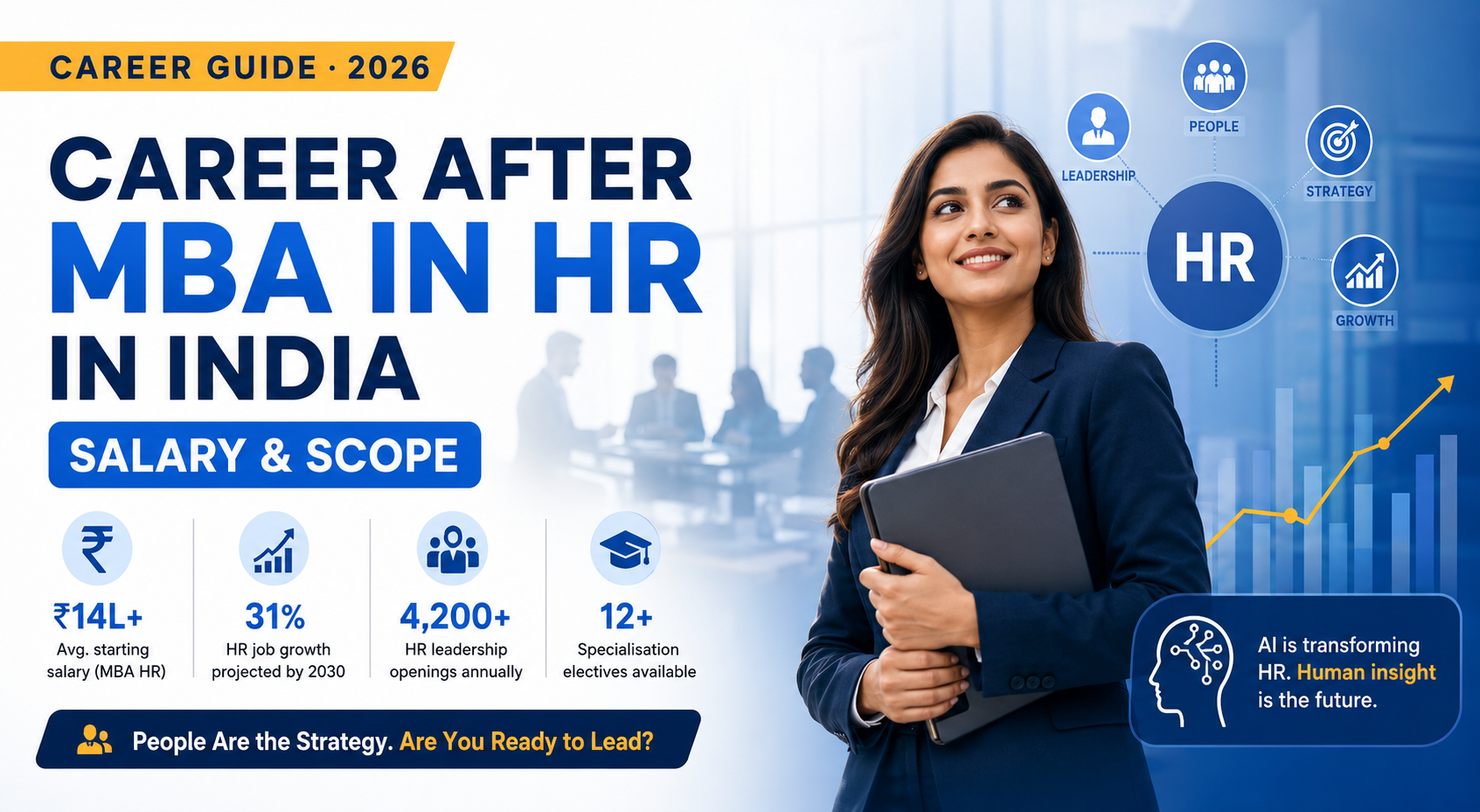
A thoughtful look at what a career in HR management can offer in 2026 and beyond, from salaries and specialisations to the AI-powered future of the profession.
There is a quiet irony at the heart of the HR profession: it is the function most responsible for enabling every other function to thrive, yet it is often the last one people think of when imagining a high-powered business career. That perception is changing rapidly. Across industries from technology to manufacturing, from banking to healthcare, organisations are waking up to the fact that talent strategy is business strategy. And for anyone considering an MBA in human resource management in India, that shift represents an extraordinary opportunity to step into a role that sits at the very centre of how modern organisations grow, adapt, and endure.
India's workforce of over 500 million people is the largest and youngest in the world. Managing that talent, attracting it, developing it, retaining it, and aligning it with organisational goals is one of the defining challenges of our economic moment. Professionals who understand both the human and the business dimensions of this challenge are in high demand, and that demand is only accelerating.
- ⚬ What the Path Actually Looks Like in 2026
- ⚬ Numbers That Make the Conversation Easier
- ⚬ A Career With Room to Grow in Every Direction
- ⚬ The Most Important Disruption in the Profession
- ⚬ Where the Talent Market Is Heading
- ⚬ When Data Becomes Your Most Powerful Tool
- ⚬ The Long View: What This Career Looks Like at Its Peak
- ⚬ Choosing Where You Begin
- ⚬ Frequently Asked Questions
What the Path Actually Looks Like in 2026
The honest answer is that the career after MBA HR 2026 looks quite different from what it did even five years ago. The old image of HR as a purely administrative back-office function processing payroll, managing leave records, and handling compliance is being replaced by something far more strategic. Today's HR leaders are involved in workforce planning that spans five-year horizons, in building employer brands that compete for top talent globally, and in designing people experiences that directly influence innovation and productivity.
The entry points are also more varied. Graduates are stepping into roles in talent management, employee experience design, HR technology implementation, people analytics, and organisational development. Within three to five years of post-MBA experience, many professionals are moving into senior advisory or leadership positions a pace of career progression that is notably faster than in many other management disciplines.
| Role | Salary Range (Annual) |
|---|---|
| HR Business Partner | ₹10L – ₹20L/yr |
| Talent Acquisition Manager | ₹12L – ₹22L/yr |
| HR Analytics Specialist | ₹14L – ₹26L/yr |
| Chief People Officer | ₹30L – ₹80L/yr |
| Learning & Development Head | ₹15L – ₹30L/yr |
| Compensation & Benefits Mgr | ₹12L – ₹24L/yr |
Numbers That Make the Conversation Easier
When it comes to MBA HR jobs and salary in India, the picture is more compelling than many people expect. Entry-level roles in HR management at reputed organisations typically begin between ₹8 and ₹14 lakhs annually. HR business partners and people analytics managers with three to five years of experience routinely command packages between ₹18 and ₹30 lakhs. At the senior end, Chief People Officers, VP-HR, and Head of Talent roles at large corporations, the compensation regularly exceeds ₹50 lakhs, with performance-linked bonuses and equity components becoming increasingly common even in Indian contexts.
The salary trajectory in HR is closely tied to the strategic value a professional brings to the table. Those who combine deep people expertise with business acumen and data literacy tend to progress faster and earn more than those who remain purely transactional in their approach. The degree is the starting point; the mindset is the multiplier.
The Freedom to Learn Without Pausing Your Career
One of the most significant shifts in postgraduate education over the past decade is the quality and credibility of distance and digital learning. The online MBA HR India landscape has matured enormously. Programmes now offer live faculty-led sessions, peer cohorts drawn from diverse industries, mentorship from practising HR leaders, and capstone projects with real-world applications. For working professionals already in HR, operations, or people management roles, this format offers the ideal combination: career continuity with academic deepening.
The ability to apply each module's learning directly at work, testing frameworks in real teams, and presenting data to actual stakeholders transforms the MBA experience from a theoretical exercise into genuine professional development. Many students report that their organisations benefit from the programme almost as much as they do personally.
"In every boardroom, in every start-up, in every policy room, the most consequential decisions eventually come down to one question: do we have the right people? Someone has to answer that. It might as well be you."
A Career With Room to Grow in Every Direction
One of the most underappreciated aspects of specialising in HR is how broad the lateral career options become over time. HR management career growth does not follow a single linear path. A professional might begin in talent acquisition, then move into learning and development, then pivot into HR technology consulting, and eventually step into a CHRO role at a technology firm. Or they might build deep expertise in compensation design and become a sought-after specialist across industries. The field rewards both generalists who can hold the whole people strategy together and specialists who go deep in one critical domain.
The organisations doing the hiring are equally diverse. Multinational corporations, Indian conglomerates, government enterprises, start-ups, NGOs, and international organisations like the United Nations and World Bank all employ HR management graduates in senior roles. The breadth of the field is, by any measure, one of its greatest strengths.
The Most Important Disruption in the Profession
No conversation about HR careers in 2026 can avoid the subject of artificial intelligence. Understanding MBA HR scope in the AI era is not about fearing what machines will automate; it is about recognising what human expertise becomes more valuable as a result. AI is already handling resume screening, attendance analytics, engagement surveys, and preliminary interview scheduling. What it cannot do is exercise judgement about culture, build trust with a hesitant employee, navigate a sensitive organisational conflict, or inspire a team through a difficult transition. Those capabilities rooted in emotional intelligence, contextual understanding, and ethical reasoning are precisely what a strong HR leader brings.
The professionals who will thrive in the AI-augmented HR environment are those who understand both sides of the equation: how to deploy technology intelligently, and how to protect and develop the irreplaceable human dimensions of work. That is not a threat it is an upgrade in what the profession demands.
Where the Talent Market Is Heading
The role of a talent acquisition manager with an MBA has arguably seen the most dramatic transformation of any HR specialisation in recent years. India's rapid expansion in sectors like semiconductors, green energy, aerospace, and digital infrastructure has created acute shortages of specialised talent, and organisations are willing to pay premium salaries for professionals who can build the pipelines to fill them. Talent acquisition today involves employer branding, workforce planning, diversity hiring strategy, campus relations, and global sourcing, a multidimensional function that demands both strategic thinking and operational rigour.
For those entering this specialisation, the career upside is significant. Senior talent acquisition leaders are now routinely included in business expansion discussions, and the best among them are considered core members of the executive team rather than support staff.
When Data Becomes Your Most Powerful Tool
Perhaps the fastest-growing specialisation within the HR profession is people analytics. An HR analytics career MBA prepares professionals to move beyond intuition-based decisions and into evidence-based people strategy. Using workforce data to understand attrition patterns, predict high performers, model the ROI of training investments, and identify flight risks before they become resignations, these are capabilities that organisations are actively seeking and willing to invest in significantly.
The combination of HR domain expertise and data literacy is rare and therefore extraordinarily valuable. Professionals in this space often work at the intersection of HR and technology, partnering with data science teams, implementing HRIS platforms, and presenting people insights directly to CEOs and boards. For quantitatively inclined candidates who want to stay in the people space, this is perhaps the single most exciting career direction in the field.
The Long View: What This Career Looks Like at Its Peak
Thinking about the MBA HR future scope requires looking past the immediate job market and considering where the profession is heading structurally. Several forces are converging to elevate HR to a genuinely strategic function: the complexity of managing hybrid and distributed teams, the growing importance of organisational culture as a competitive differentiator, the regulatory complexity around workforce diversity and inclusion, and the rise of AI-driven automation that demands careful human oversight. Each of these forces creates new demand for HR leaders with sophisticated management education and deep people expertise.
The CHRO (Chief Human Resources Officer) role, once considered a second-tier C-suite position, is now increasingly seen as a succession pathway to the CEO, particularly in people-intensive industries like professional services, healthcare, education, and consumer brands. The next generation of HR leaders will not just manage people; they will shape organisations.
Choosing Where You Begin
With so many options on the table, the question becomes one of fit. The best HR management MBA in India is ultimately the one that combines a rigorous curriculum with strong industry connections, experienced faculty, and a peer community that challenges and inspires you. Look for programmes that go beyond textbook HR and include live case studies, industry mentors, and electives that let you pursue your specific interest, whether that is analytics, talent strategy, organisational behaviour, or international HR. The quality of your cohort and your faculty will shape your perspective far more than any individual course.
The decision to invest in a postgraduate management degree is never entirely straightforward. But in a field as dynamic, as human, and as consequential as HR, there are few investments with a clearer and more durable return both professionally and personally.
Frequently Asked Questions
Yes, and the argument for it is stronger in 2026 than it has been in years. The convergence of AI-driven workplace transformation, India's demographic advantage, and the growing recognition that talent strategy is business strategy has elevated HR to a genuinely strategic function. Graduates entering the field now are doing so at a moment when the profession is being redefined upward, not sideways. Entry pathways are diverse, compensation is rising, and the ceiling for those who bring both business acumen and people insight is high.
Entry-level roles typically start between ₹8 and ₹14 lakhs per annum. With three to five years of experience, HR business partners and people analytics professionals earn between ₹18 and ₹35 lakhs. Senior HR leaders, VP-HR, CHRO, and Head of People roles at large organisations regularly exceed ₹50 lakhs, with performance bonuses and equity adding further upside. Salaries in consulting, technology, and financial services tend to be higher than the industry average.
AI is automating the transactional and repetitive aspects of HR resume screening, scheduling, attendance tracking, and basic query resolution. This is freeing HR professionals to focus on what cannot be automated: building culture, developing leaders, navigating complex interpersonal dynamics, and designing equitable people systems. The net effect is that AI is raising the floor on what HR professionals are expected to do, which makes quality management education more valuable, not less. Professionals who understand both the technology and the human dimensions of work will be the most sought-after.
Government and public sector opportunities for HR graduates are more substantial than most people realise. Roles include HR Officer and Assistant Director positions in central and state PSUs, Labour Welfare Officer posts under the Ministry of Labour, HR and administration roles in organisations like the Railways, DRDO, ONGC, SAIL, and BHEL, and specialist roles in bodies like UPSC, SSC, and State Public Service Commissions. Postgraduate management graduates may also qualify for HR-related IAS/IPS deputation roles and international positions within organisations like UNDP, ILO, and WHO operating in India.
Absolutely. Indian HR professionals with postgraduate management qualifications are sought after in the Gulf (UAE, Saudi Arabia, Qatar), Southeast Asia (Singapore, Malaysia), the UK, Canada, and Australia, particularly in sectors where Indian diaspora organisations operate at scale. Multinational corporations hiring in India also regularly place high-performing HR professionals in regional and global roles. Specialisations in HR analytics, talent acquisition, and compensation design tend to travel particularly well across borders, as these skill sets are globally standardised and in consistent demand.


