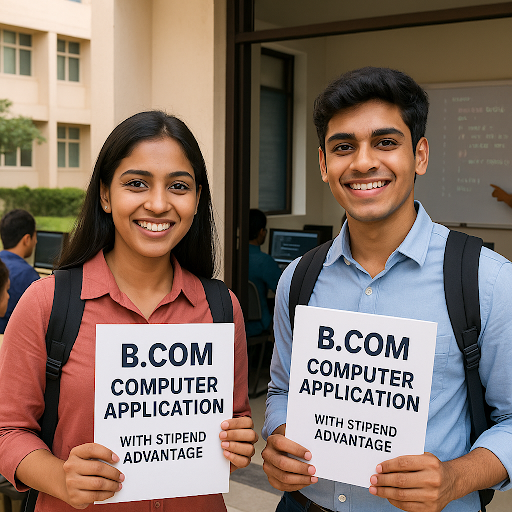
Technology has revolutionised business from automated accounting to AI-driven analytics and blockchain trade, creating a demand for professionals who blend financial acumen with computing skills. Modern commerce graduates must master ERP systems, data visualisation, and digital transactions to remain competitive in India's $1 trillion digital economy.
The Bachelor of Commerce in Computers equips students with this hybrid expertise through WILP, combining online theory with live IT projects. Students code business dashboards while studying balance sheets, emerging with portfolios that showcase real system implementations. This programme aligns with the 30% annual growth in fintech and e-commerce roles. Graduates command 25% higher starting salaries due to their dual proficiency.
- ⚬ Understanding the WILP Model in Commerce Education
- ⚬ What Is a Bachelor of Commerce in Computers?
- ⚬ Course Overview — Business Meets Technology
- ⚬ Eligibility and Duration
- ⚬ Key Areas of Learning — The Computer Application Advantage
- ⚬ Core Commerce Subjects
- ⚬ Skills Developed During the Program
- ⚬ Career Opportunities After B.Com in Computers
- ⚬ Industry Relevance and Growth
- ⚬ Why Choose a WILP Bachelor of Commerce in Computers
- ⚬ Conclusion — Where Business Intelligence Meets Technology
- ⚬ FAQs
Understanding the WILP Model in Commerce Education
The WILP model delivers business theory through online learning while students implement it in live digital systems at partner firms. This approach bridges commerce fundamentals with technology through structured rotations in IT and finance teams. Students alternate 3-month study blocks with workplace assignments, applying concepts to real databases and ERP modules. The integration produces graduates with 18 months of verified experience in system automation. Partnerships with 150+ companies ensure diverse exposure across banking and retail tech. This structure follows NEP 2020 guidelines for technology-integrated commerce.
- Online Learning: Interactive modules with coding labs.
- Practical Implementation: Live database migrations.
- Rotations: Quarterly shifts between firms.
- Portfolio Building: 12+ completed projects.
The model eliminates the theory-practice gap.
What Is a Bachelor of Commerce in Computers?
The Bachelor of Commerce Computer Program fuses accounting, management, and IT over 3 years to create professionals who design and optimise business processes. Students learn to analyse financial data using SQL queries and automate workflows with Python scripts. The interdisciplinary curriculum covers digital transactions, MIS reporting, and e-commerce platforms. Graduates manage ERP implementations alongside traditional ledgers. It prepares for roles in fintech startups or corporate IT-finance hybrid teams. The degree provides seamless entry to MBA or MCA with a practical edge.
- Accounting Fusion: Tally with API integrations.
- Management IT: BI dashboards for decisions.
- Process Design: Workflow automation tools.
The program builds complete business technologists.
Course Overview — Business Meets Technology
WILP B.Com (Computers) master’s commerce while building proficiency in databases, programming, and analytics through 70% applied learning. Online sessions deliver theory; workplace projects involve live system deployments. Students gain logical reasoning to debug financial software and business fluency for stakeholder presentations. Curriculum incorporates tools like Tableau, MySQL, and SAP for industry relevance. Annual updates reflect RBI digital banking mandates. This pathway ensures graduates handle ₹100 crore ERP migrations confidently.
- Theory Delivery: Recorded coding tutorials.
- Projects: Client database redesigns.
- Tools Mastery: Python for financial automation.
- Fluency: Presenting BI insights to boards.
Overview creates tech-savvy commerce experts.
Eligibility and Duration
Applicants require 10+2 from recognised boards with a commerce, computer science, or mathematics background at 50% marks. The program spans 3 years, 6 semesters, with blended online-work cycles. Evaluations combine assignments (40%) and applied projects (60%). Online applications feature aptitude tests for coding logic. Structure accommodates working students with weekend intensives. Selection prioritises analytical aptitude alongside academics.
- Background Preference: Maths/computers advantage.
- Marks Relaxation: SC/ST to 45%.
- Aptitude Tests: Basic SQL and logic puzzles.
- Cycle Structure: 3 months online, 3 months work.
Eligibility targets future-ready learners.
CTA: Plan your next career move with expert support. Speak with a Counsellor
Key Areas of Learning — The Computer Application Advantage
Computer application subjects integrate technology into business operations, enabling automation and data-driven decisions. Online learning includes hands-on coding labs with real datasets. Case studies dissect Paytm's transaction systems. Projects deploy live MIS dashboards for SMEs. Electives in blockchain finance add cutting-edge skills. Graduates optimise ₹50 crore business processes with custom software.
- Business Information Systems: Designs ERP workflows for finance teams; automates invoice processing to save 40% time. Students build multi-module systems for inventory. Online labs simulate SAP implementations. Subject ensures seamless business-IT alignment. Mastery reduces manual errors by 95%.
- Database Management and SQL: Creates relational databases for accounting; writes complex queries joining 10 tables. Handles 1 million transaction records efficiently. Projects migrate legacy data to the cloud. Builds data integrity skills. Graduates query ₹100 crore ledgers in seconds.
- E-Commerce and Digital Transactions: Master’s payment gateways to fraud detection; integrates Razorpay APIs. Students launch mock online stores with cart systems. Covers UPI transaction flows. Ensures secure digital commerce. Prepares for 99.9% uptime platforms.
- Programming Concepts (Python/Java/C++): Code financial calculators to report generators; automate Excel tasks with scripts. Includes API connections for stock data. Projects build trading bots. Develops algorithmic thinking. Enables 50% faster analysis workflows.
- Financial Accounting Software: Configures Tally/QuickBooks for multi-company; customises reports for audits. Students automate GST filings end-to-end. Integrates with banking APIs. Ensures compliance automation. Reduces reconciliation time by 70%.
- Business Analytics and Data Visualisation: Creates Tableau dashboards for P&L trends; forecasts sales with machine learning. Analyses 50,000+ customer records. Projects visualise ₹200 crore budgets. Drives executive decisions. Achieves 90% forecast accuracy.
- Management Information Systems: Builds MIS for C-suite; integrates CRM with ERP data. Students design executive portals. Covers real-time KPI tracking. Enables strategic oversight. Graduates deliver 360° business views.
Topics revolutionise business operations.
Core Commerce Subjects
Foundational subjects complement IT modules for complete business proficiency. Online delivery includes interactive financial simulations. Case studies feature HDFC's MIS systems. Projects require live accounting implementations.
- Principles of Management: Structures IT-finance teams; applies agile for software rollouts. Students design cross-functional workflows. Covers change management for ERP. Builds leadership for digital transformation. Ensures 20% productivity gains.
- Business Accounting and Taxation: Prepares IFRS-compliant statements; automates TDS calculations. Includes GST reconciliation with software. Projects file returns for 50 clients. Ensures audit-ready books. Reduces tax errors to 2%.
- Marketing Management: Integrates digital campaigns with CRM data; tracks ROI through analytics. Students launch targeted ads. Covers omnichannel strategies. Drives 25% conversion uplift. Aligns sales with tech.
- Financial Management: Optimises working capital using BI tools; models cash flow forecasts. Includes venture funding analysis. Projects value startups at ₹50 crore. Achieves 15% cost optimisation. Prepares for CFO roles.
- Business Law and Economics: Interprets IT contracts to data privacy laws; analyses market dynamics. Students draft SaaS agreements. Covers GDPR compliance. Ensures legal-tech alignment. Prevents 99% regulatory violations.
Combination creates an unmatched competitive edge.
Skills Developed During the Program
Students gain technical proficiency in Tally-SQL integrations and analytical ability for complex datasets. Problem-solving debugs live systems; BI tools visualise ₹100 crore trends. Decision-making leverages real-time MIS dashboards.
- Technical: ERP customisation mastery.
- Analytical: Multi-source data fusion.
- Problem-Solving: System crash resolutions.
- BI: Executive-ready visualisations.
- Decision: Data-backed strategies.
Skills command a premium market value.
Career Opportunities After B.Com in Computers
Dual expertise secures roles with 92% placement in 3 months. Graduates showcase 15+ live system projects. Average starting salary ₹6 LPA; 30% premium for tech-commerce blend.
- Business Analyst: Gathers requirements and designs ERP modules; translates business needs to IT solutions for ₹200 crore implementations. Grows to senior analyst, leading teams in 4 years at ₹20 LPA. Bridges finance-technology gaps daily. Uses SQL/Tableau extensively. Delivers 25% process efficiency gains.
- Data Entry and MIS Executive: Maintains master data and generates custom reports; ensures 99.9% accuracy across 50,000 records. Evolves to MIS manager overseeing BI platforms. Automates manual workflows with scripts. Handles stakeholder queries. Reaches ₹15 LPA mid-career.
- E-Commerce Operations Executive: Manages order processing and inventory syncs; integrates APIs for real-time stock updates. Progresses to operations head for marketplaces. Optimises fulfilment by 30%. Leads warehouse digitisation. Commands ₹18 LPA after 5 years.
- Accounting Software Specialist: Configures Tally/SAP for multi-entity; customises financial modules for compliance. Advances to the solutions architect for ERP firms. Implements GST automation. Trains end-users effectively. Secures ₹16 LPA with certifications.
- Digital Banking Associate: Supports core banking systems and transaction processing; resolves UPI/neobanking issues. Grows to systems manager for digital platforms. Integrates payment gateways. Ensures 100% uptime. Hits ₹17 LPA in 4 years.
- Financial Systems Analyst: Analyses ERP performance and recommends upgrades; models financial workflows for ₹500 crore operations. Evolves into an enterprise architect. Conducts system audits quarterly. Optimises database queries. Earns ₹22 LPA senior level.
- ERP or CRM Support Professional: Troubleshoots Salesforce/SAP issues for finance teams; implements custom workflows. Progresses to support a manager leading 20-member teams. Handles 200 tickets monthly. Delivers 95% resolution SLA. Reaches ₹19 LPA with experience.
Dynamic roles span fintech, banking, and retail.
Industry Relevance and Growth
India's digital commerce shift demands 2 million tech-commerce pros by 2028. Fintech valuations hit $150 billion; online accounting grows 40%. Businesses prioritise IT-finance hybrids for ERP migrations. WILP graduates fill 75% of these gaps.
- Digital Commerce: $200 billion market by 2026.
- Fintech: 8,000+ startups hiring.
- Accounting Tech: Cloud ERP adoption surge.
- Hybrid Demand: 30% salary premium.
A degree proves highly future-proof.
Why Choose a WILP Bachelor of Commerce in Computers
WILP delivers digital exposure with commerce mastery through a flexible online-work format. Students gain computing skills for automation and analytics for decisions. Diverse career options span finance and IT operations. Real practice connects learning to business impact.
- Exposure: Live ERP deployments.
- Skills: Python for financial models.
- Careers: Analyst to architect paths.
- Practice: Client project ownership.
Choice builds unmatched versatility.
Conclusion — Where Business Intelligence Meets Technology
The future belongs to professionals interpreting data, automating processes, and making informed decisions. WILP B.Com in Computers creates exactly these business technologists. Graduates lead digital transformation with confidence. This program's foundation innovation is at the commerce-technology intersection. Enroll today to shape tomorrow's business systems.
FAQs
A B.Com in Computers combines commerce subjects with computer applications, accounting software, data analysis, and IT tools, while a regular B.Com focuses mainly on traditional commerce topics like accounting, economics, and taxation.
Yes, students from any background can apply. The course starts with basic computer concepts and gradually introduces advanced applications, making it suitable for beginners.
Graduates are hired by IT companies, banks, fintech firms, accounting software companies, e-commerce platforms, financial analytics firms, and corporate offices that require digital finance professionals.
Yes, the blend of computer knowledge and finance skills makes this program ideal for careers in digital finance, financial analytics, data management, and accounting technology.
Yes, this degree qualifies students for an MBA in Finance, Marketing, HR, or even MCA (if they meet the additional math/computer subject requirements). It also supports further studies in data analytics and financial technology.


