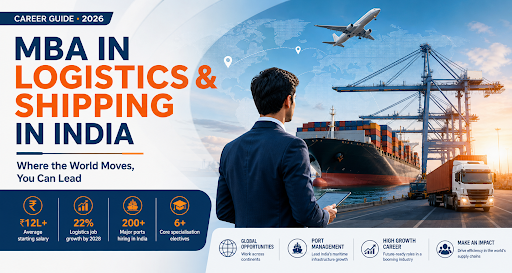
CAREER GUIDE · 2026
A candid look at what a postgraduate degree in shipping and logistics management can open up and whether it is the right move for you.
The global supply chain is not a background function. It is the circulatory system of modern commerce. When it stutters, as the world witnessed between 2020 and 2024, entire economies pause. And yet, despite its colossal scale, it remains acutely short of qualified professionals who can think both strategically and operationally. That is precisely where the value of pursuing an MBA in logistics and shipping in India becomes most visible, not just as a credential, but as a career accelerant in one of the most critical industries of our time.
India is no exception to this global demand. With major ports processing record volumes and the government's Sagarmala programme continuing to invest thousands of crores into port modernisation, the sector needs leaders who understand finance, operations, law, and global trade simultaneously. A postgraduate management degree in this domain provides exactly that breadth and depth in one.
₹12L+
Average starting salary
22%
Logistics job growth by 2028
200+
Major ports hiring in India
6+
Core specialisation electives
- ⚬ What Does a Career in This Field Actually Look Like?
- ⚬ The Horizon Looks Wide as It Should
- ⚬ What the Numbers Say About Compensation
- ⚬ Learning on Your Own Schedule
- ⚬ Anchored in the Sea, Built for the Future
- ⚬ Beyond Shipping: The Bigger Picture of Supply Chain Leadership
- ⚬ Who's Actually Hiring and Where
- ⚬ Running a Port Is a Management Job
- ⚬ The Decision That Changes Your Trajectory
- ⚬ Frequently Asked Questions
What Does a Career in This Field Actually Look Like?
It is easy to picture logistics as warehouses and shipping containers. But the reality of a career after an MBA in shipping management is far more textured than that. Graduates step into roles that demand negotiation, risk management, regulatory compliance, and cross-cultural communication, often on the same day. One morning might involve reviewing port tariff structures; the afternoon, briefing a board on emerging trade corridor opportunities in Southeast Asia.
The career paths available are genuinely varied. Some professionals lean into operations, becoming port managers or terminal heads. Others move into consulting, helping shipping companies reduce dead freight and optimise container utilisation. And a growing number are entering the policy space, working with ministries and international bodies to shape the future of maritime trade governance.
| Role | Salary Range (Annual) |
|---|---|
| Port Operations Manager | ₹10L – ₹18L/yr |
| Logistics Strategy Lead | ₹12L – ₹22L/yr |
| Maritime Trade Consultant | ₹14L – ₹28L/yr |
| Supply Chain Director | ₹18L – ₹40L/yr |
The Horizon Looks Wide as It Should
One question that any prospective student should ask is whether the field has staying power. When it comes to shipping management MBA scope 2026, the answer is an unambiguous yes. India's National Logistics Policy, the expansion of dedicated freight corridors, and the rapid rise of 3PL providers have collectively created a surge in demand for professionals who can manage scale and complexity. Combine that with India's aspiration to become a global transhipment hub, and you have a sector poised for sustained growth over the next decade.
The scope extends well beyond the domestic market. Indian professionals trained in shipping and port management are sought after in Singapore, Dubai, Rotterdam, and beyond, wherever freight volumes are significant and operational expertise is valued.
What the Numbers Say About Compensation
Money matters, and there is no reason to be vague about it. When it comes to MBA logistics salary in India, the data reflects an industry that rewards expertise generously. Entry-level roles at leading shipping companies, freight forwarders, and logistics conglomerates typically start between ₹8 and ₹12 lakhs annually. Mid-career professionals, particularly those who move into supply chain strategy or port administration, regularly earn between ₹18 and ₹35 lakhs. At the senior level, the figures become considerably more compelling.
Beyond the base salary, the sector offers additional advantages: international postings with cost-of-living adjustments, performance bonuses tied to freight volume, and in many cases, employer-sponsored professional development programmes. This is a field where your compensation tends to move with your expertise, not just your tenure.
Learning on Your Own Schedule
Not every ambitious professional has the luxury of stepping away from work entirely to pursue further education. Fortunately, the landscape has changed. Online MBA logistics India programmes have matured significantly, offering the same rigorous curriculum, freight operations, international trade law, supply chain analytics, and risk management, with the flexibility of remote learning. Live virtual sessions, industry mentors, and collaborative project modules ensure that the learning experience remains deeply practical, not just theoretical.
For working professionals already embedded in shipping, freight, or trade-related industries, this format is particularly compelling. You can apply what you learn in the classroom directly to your workplace the very next day a feedback loop that accelerates both professional growth and academic understanding.
Anchored in the Sea, Built for the Future
There is something uniquely compelling about the maritime dimension of this field. A maritime MBA in India is not just about ships and ports in the traditional sense; it is about understanding the geopolitics of trade routes, the economics of vessel chartering, and the environmental imperatives reshaping global shipping. The International Maritime Organisation's decarbonisation mandates are opening entirely new career pathways in sustainable shipping operations and green port development.
India's coastline stretches over 7,500 kilometres, and the country is home to twelve major ports and hundreds of minor ones. For anyone drawn to the intersection of commerce, strategy, and the ocean, this is a field of extraordinary scope.
Beyond Shipping: The Bigger Picture of Supply Chain Leadership
While maritime operations form one pillar of this degree, the supply chain MBA career scope extends far beyond the docks. Modern supply chains span air freight, rail, road logistics, cold-chain management, and increasingly, digital platforms that orchestrate movement through real-time data. Graduates trained in end-to-end supply chain thinking are equipped to step into leadership roles in e-commerce logistics, pharmaceutical distribution, automotive supply chains, and FMCG.
The ability to see the entire chain from raw material procurement through to last-mile delivery and to optimise it both financially and operationally is a skill set that commands respect and compensation across virtually every industry.
Who's Actually Hiring and Where
When it comes to MBA shipping jobs in India, the hiring landscape is broader than most candidates initially expect. Yes, the obvious names are there: Maersk, MSC, CMA CGM, Adani Ports, DP World. But the demand stretches into logistics technology companies building routing algorithms, customs clearance firms navigating complex tariff frameworks, and government-affiliated bodies overseeing port development projects. The India-Middle East-Europe Economic Corridor (IMEC) is likely to create a fresh wave of demand for qualified shipping and logistics managers in the years ahead.
Placement outcomes for graduates of well-regarded programmes have consistently pointed to roles in these sectors, with several students receiving offers before they have even completed their final semester.
Running a Port Is a Management Job
It is worth pausing on one specialisation that is often underappreciated: port management MBA as a career pathway is distinctly powerful in India's current economic climate. Ports are increasingly being run as full-scale commercial enterprises with revenue targets, stakeholder management, capital infrastructure planning, and regulatory compliance all converging on a single leadership team. Managing a port today requires the same calibre of strategic thinking as running any mid-sized corporation, with the added complexity of tides, vessels, and international customs.
Graduates who move into port operations and terminal management find themselves at the centre of India's most ambitious infrastructure story, and that is a meaningful place to build a career.
The Decision That Changes Your Trajectory
If you are weighing your options and wondering whether further specialisation is worth it, consider this: every major disruption of the past decade has shone a spotlight on the acute shortage of trained logistics professionals. When a crisis reveals a skills gap, it also reveals an opportunity. The logistics career after an MBA is not just about climbing an internal ladder at a single company. It is about becoming someone the industry looks to for solutions, for leadership, for institutional knowledge that cannot be found in a search engine.
That kind of professional standing is built deliberately, starting with the right education and sustained by the right combination of experience, curiosity, and ambition. If any part of this resonates with you, the next step may be closer than you think.
Frequently Asked Questions
The scope is exceptionally broad and continues to expand. Graduates are employable across port operations, freight forwarding, supply chain consulting, logistics technology, maritime law support, and government infrastructure bodies. India's ongoing port modernisation and trade corridor development ensure that this scope will remain robust well into the next decade. Internationally, Indian professionals trained in this field are sought after in major freight hubs including Dubai, Singapore, and Rotterdam.
Entry-level roles typically begin at ₹8 to ₹12 lakhs per annum, depending on the company, city, and specific function. With three to five years of post-MBA experience, professionals in mid-level strategy or operations roles can expect packages in the ₹18 to ₹30 lakh range. Senior leadership roles frequently exceed ₹40 lakhs, with international postings commanding additional allowances.
It depends on your goals. A general MBA offers wider optionality; a specialised programme in shipping and logistics offers deeper credibility and faster career traction within a defined, high-demand sector. If you are drawn to maritime trade, port operations, or global supply chain management or if you already work in this space, the specialised route will open doors that a general degree simply will not. Employers in shipping consistently prioritise domain knowledge alongside management skills.
Absolutely. Online formats for this specialisation have grown significantly in quality and structure. They are specifically designed for professionals who want to deepen their expertise without pausing their careers. Courses are delivered through live virtual sessions, self-paced modules, and collaborative industry projects. For mid-career professionals in shipping, freight, or logistics, this format is particularly well-suited the coursework often applies directly to current workplace challenges.
The primary recruiters span shipping lines (Maersk, MSC, CMA CGM), port and terminal operators (Adani Ports, DP World, JNPA), freight forwarding and customs firms, e-commerce logistics companies, 3PL/4PL providers, logistics technology startups, pharmaceutical cold-chain specialists, and government bodies under the Ministry of Ports, Shipping and Waterways.


