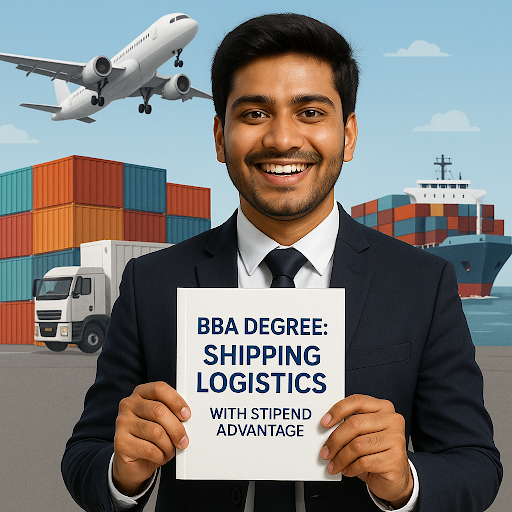
The logistics and shipping sector powers 90% of global trade, connecting industries through seamless goods movement. India handles ₹50 lakh crore in annual exports, demanding skilled professionals for efficiency. A specialised BBA equips students with management expertise tailored to this domain.
This BBA Shipping and Logistics Overview highlights its role in e-commerce, manufacturing, and international business.
- ⚬ Understanding the Academic Core
- ⚬ Curriculum at a Glance
- ⚬ Admission Essentials and Program Duration
- ⚬ The Emerging Model — Learning While Working
- ⚬ How Work-Integrated Programs Function in Reality
- ⚬ Skills Students Develop During the Program
- ⚬ Exploring Career Paths After Graduation
- ⚬ The Industry Landscape and Future Potential
- ⚬ Why Choose a Specialised BBA in Logistics
- ⚬ Conclusion
- ⚬ FAQs
Understanding the Academic Core
A BBA in Logistics and Supply Chain Management focuses on systems optimisation, technology integration, and relationship building across supply networks. It combines business principles with operational strategies for end-to-end efficiency. Graduates manage complex chains from procurement to delivery.
- Systems Management: Inventory control and route planning.
- Technology Role: AI tracking for real-time visibility.
- Relationship Building: Vendor negotiations globally.
Core prepares for industry challenges.
Curriculum at a Glance
The BBA logistics and supply chain syllabus blends management theory with practical logistics modules over 3 years. Semesters progress from basics to advanced applications.
- Year 1 Focus: Foundation in business and economics.
- Year 2 Depth: Core operations and transport systems.
- Year 3 Specialisation: Analytics and global trade.
Syllabus aligns with industry standards.
What Students Learn — Subject Insights
Subjects are divided into tiers for progressive mastery.
Basic Management:
- Principles of Management: Organisational structures for logistics firms.
Core Logistics:
- International Trade and Maritime Economics: Export cycles and freight pricing.
- Port and Terminal Management: Container handling at 50+ Indian ports.
- Supply Chain Analytics: Data models for demand forecasting.
The BBA logistics subjects list builds practical trade understanding.
Admission Essentials and Program Duration
BBA logistics eligibility and duration require 10+2 from any stream. The program spans 3 years, 6 semesters with internships integrated for 3 to 6 months. The duration includes mandatory training.
The Emerging Model — Learning While Working
Work-linked BBA in Logistics merges academics with paid industry exposure. Students alternate between study and workplace modules. Employability rises 40% through practical integration. Models suit commerce graduates seeking early earnings.
- Alternating Schedule: 3 months study, 3 months work.
- Stipend Benefit: ₹15,000 monthly average.
- Credit Link: Training counts towards the degree.
Model accelerates readiness.
How Work-Integrated Programs Function in Reality
How a work-integrated BBA works in structured cycles.
- Step 1: Learning modules on theory.
- Step 2: On-site training at ports/firms.
- Step 3: Mentored projects with evaluations.
- Cycle Example: Semester 1 study, Semester 2 internship.
- Mentorship: Industry supervisors guide tasks.
- Stipend: ₹12,000-18,000 based on location.
- Evaluation: 50% academic, 50% workplace performance.
Function ensures seamless transition.
CTA: For personalised assistance, our counsellors are available to listen, advise, and support you. CONNECT NOW
Skills Students Develop During the Program
Industry skills in shipping & logistics include inventory optimisation and digital systems proficiency. Students master data interpretation for decision-making. Negotiation and leadership handle global teams.
- Inventory Management: Stock level balancing to cut costs by 15%.
- Data Interpretation: Analytics for route efficiency.
- Negotiation: Vendor contracts saving 10%.
- Digital Systems: SAP navigation for tracking.
- Leadership: Team coordination in crises.
Skills meet employer demands.
Exploring Career Paths After Graduation
Careers after BBA logistics and supply chain offer an average of ₹5.5-7 LPA.
- Logistics Coordinator: Shipment scheduling; ₹5.5 LPA.
- Operations Analyst: Process improvement; ₹6 LPA.
- Supply Chain Executive: Vendor management; ₹6.2 LPA.
- Port Manager: Terminal oversight; ₹6.5 LPA.
- Procurement Officer: Sourcing optimisation; ₹5.8 LPA.
Growth reaches ₹20 LPA in 8 years.
The Industry Landscape and Future Potential
BBA logistics scope in India expands with the National Logistics Policy targeting $2 trillion by 2030. Digital freight and maritime hubs create 2 million jobs. Management professionals drive 25% efficiency gains.
- Policy Impact: Infrastructure investment ₹100 lakh crore.
- Digital Shift: Blockchain for secure chains.
- Demand Surge: 50,000 annual openings.
Scope ensures bright futures.
Why Choose a Specialised BBA in Logistics
This BBA provides balanced exposure and 90% employability. It opens MBA/PGDM paths or direct roles. Specialisation meets global trade needs. Counsellors recommend for ambitious commerce students.
- Exposure Balance: 50% theory, 50% practice.
- Higher Studies: Seamless MBA transition.
- Industry Entry: Immediate coordinator positions.
Choice builds leadership foundations.
Conclusion
A BBA in Shipping and Logistics foundations future leaders in the goods movement. Work-integrated options deliver experience and earnings. Connect with counsellors today to explore UGC-recognised programmes and launch your global supply chain career.
FAQs
A BBA in Shipping and Logistics focuses on managing transportation, warehousing, supply chain operations and international trade, while a regular BBA covers general business topics like marketing, finance, and HR.
Yes, students from any stream—Commerce, Science, or Arts—can apply as long as they meet the minimum eligibility criteria set by the university.
In a work-integrated BBA, you learn through live projects, internships, and industry exposure alongside your academics, helping you gain practical skills and workplace experience from the beginning of the program.
Graduates can find opportunities in logistics firms, e-commerce companies, shipping corporations, manufacturing units, export-import houses, and supply chain departments of multinational companies.
Yes, it provides a strong foundation for MBA programs, especially in fields like Supply Chain Management, International Business, or Operations, and offers better prospects for career growth and higher salary packages.


